TransDubber

TransDubber Learning Timeline-Preserving Speech-to-Speech Translation

Same words. Same voice.
Same moments.

TransDubber translates English speech into Chinese that ends where the source ends and falls silent where the speaker paused. The timing is learned by the model itself: no inference-time timing controller, no padding, truncation, or time stretching.

61.5%
of translations land within ±2% of the source duration
UniSS 25.6%TransDubber 61.5%
0.550
pause F1: source pauses reproduced at the right moment
UniSS 0.118TransDubber 0.550
0.788
COMET translation quality, kept on par
UniSS 0.784TransDubber 0.788
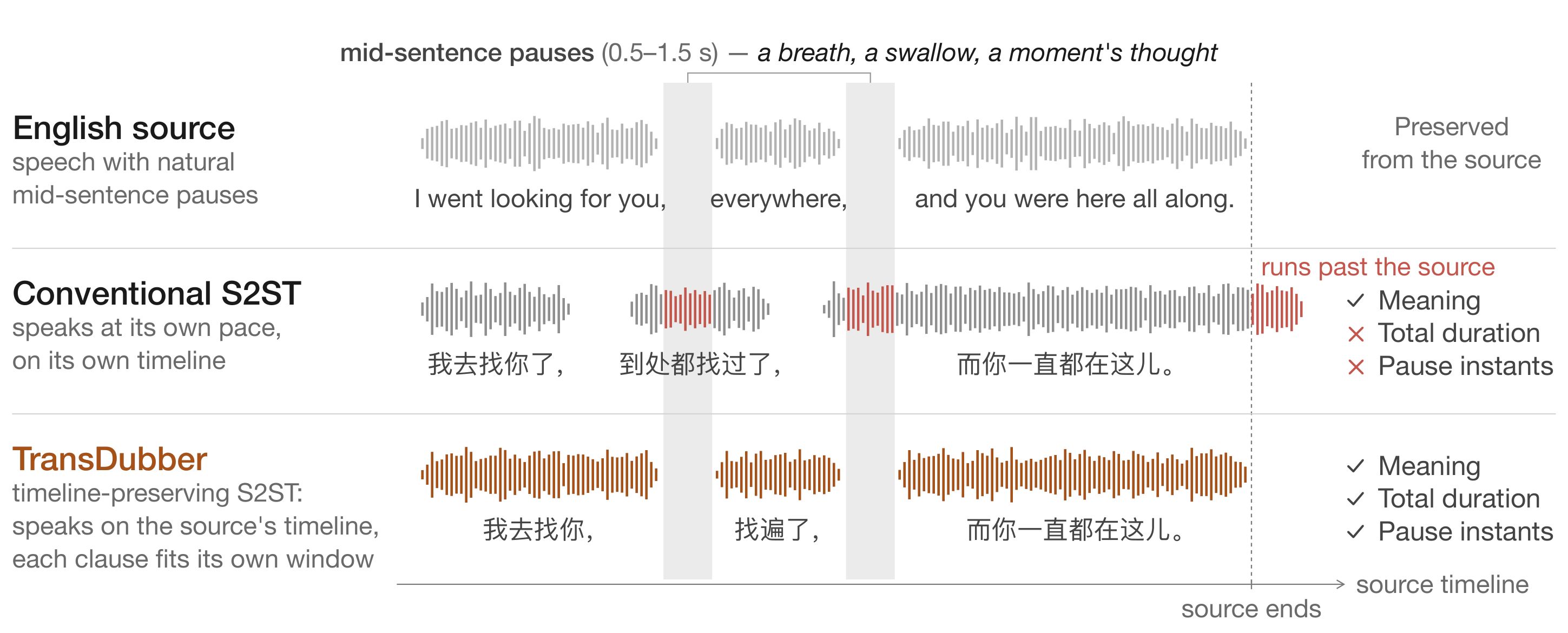
Three rows on one clock: the English source with two mid-sentence pauses; a conventional S2ST output that speaks at its own pace, shifts the pauses, and runs past the source endpoint; and TransDubber, whose Chinese clauses fit the source speaking windows and pauses.
The idea in one picture. Conventional S2ST speaks at its own pace, shifting pauses and overrunning the source endpoint. TransDubber keeps the meaning and the voice while fitting each clause into the source's speaking windows, pauses, and endpoint.
01 · Listen

Hear it keep time.

Five test utterances, seven systems, one shared clock. Every strip starts at its clip's speech onset and uses the source's time axis, so you can see whether a system pauses where the speaker paused and stops where the speaker stopped. Click a strip to seek.

source pause (≥ 0.4 s) source speech ends speech past the source endpoint TransDubber baselines

English sources from CoVoST2 (read speech) and GigaSpeech (spontaneous speech). All translations are the systems' own outputs, text and audio alike.

02 · TL;DR

Three things to take away.

Timing is treated as part of the translation target. Supervision for it is built on the source's own canvas, and an autoregressive model learns it without any timing machinery at inference.

The task

Timing is part of what gets translated.

Timeline-preserving S2ST asks the target speech to follow the source on a shared absolute clock: end where it ends, go silent where it pauses. Matching total duration alone still leaves every internal pause anywhere.

Utterance endpointpreserved
Salient pauses (≥ 0.5 s)same instants
Meaning and voicekept
The data

Targets are built on the source's canvas.

Each English speech region is re-translated under a duration budget, synthesized in the speaker's voice, and placed back into its own window on the source timeline. The result has exactly the source's length, pauses and endpoint fixed.

Duration-matched En→Zh pairs642K
Aligned pause spans298K
Length mismatch0 samples
The model

Learned, not enforced.

One autoregressive model emits a pause-marked transcript, then Chinese text and speech tokens interleaved, and decides by itself when to stop. Timeline-aligned fine-tuning establishes the behavior; verifier-guided RL sharpens the timing and recovers translation quality.

Inference-time timing controllernone
Post-hoc stretching or paddingnone
Backbone1.7B, from Qwen3-ASR
03 · How it works

Speak on the source's clock.

Parallel speech corpora never provide this supervision, because independently recorded translations follow the rhythm of the target language. So the training targets are constructed to follow the source instead, and the model is taught to reproduce them.

01
Scaffold

Read the source's rhythm.

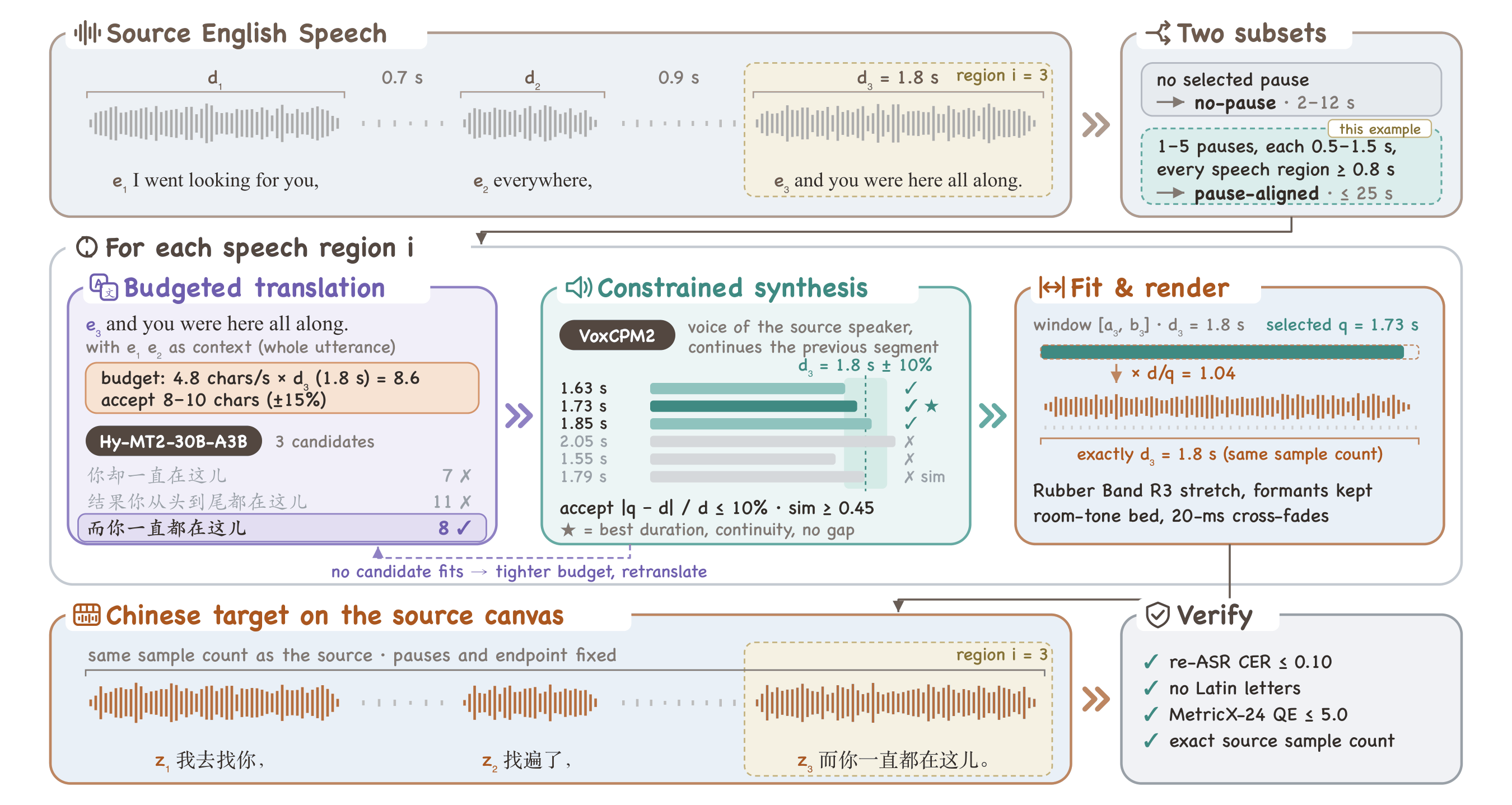
Voice-activity detection finds the speaking windows and the silences between them. Gaps of at least 0.5 s become pause boundaries, and each window is transcribed; the regions are joined with a literal <pause> marker.

02
Canvas

Fill each window with Chinese.

Every region is translated under a character budget set by its duration, with the whole utterance as context. VoxCPM2 synthesizes candidates in the speaker's voice; only those that fit the window are kept and rendered back onto the source's own room tone.

03
Train

Teach the model to keep time.

A progressive curriculum ends with supervised fine-tuning on the aligned targets and GSPO with three verifier rewards: translation quality on the text tokens, duration and pause alignment on the speech tokens.

Construction pipeline: the English source is split into speech regions at pauses; each region is translated under a character budget, synthesized with VoxCPM2 in the source speaker's voice, fitted to its source window, and rendered onto the source canvas; the result is verified with re-ASR, script purity, translation quality estimation, and exact sample count.
Building one timeline-preserving target. Budgeted translation, constrained synthesis, fit and render, then verification. If no candidate fits a window, the budget is tightened and the region is re-translated; an utterance is dropped if any window stays empty.

Four stages, one model.

TransDubber starts from Qwen3-ASR-1.7B, a recognition model that cannot translate or speak. Its vocabulary is extended with 6,561 speech-codec tokens, and it learns to emit the pause-marked English transcript, then Chinese text and speech interleaved five-to-ten, continuing speech until it decides the translation is over. Stage 3 is where source-timeline following appears; Stage 4 refines it and wins back part of the translation-quality cost of strict synchronization.

S1Text groundingpause-aware ASR and English→Chinese translation
S2Natural-pace speech warm-upinterleaved text and speech, no timing constraint
S3Timeline-preserving fine-tuning642K duration-matched targets, 298K pause spans
S4Verifier-guided RLGSPO: quality → text tokens, duration and pauses → speech tokens
04 · Results

Keeps time. Keeps meaning.

English-to-Chinese translation on 4,353 test utterances from CoVoST2 and GigaSpeech, compared with a strong cascaded pipeline, SeamlessM4T and SeamlessExpressive, Qwen2.5-Omni-7B, and UniSS. Full tables, human evaluation, and ablations are in the paper.

Isochrony

Within ±2% of the source duration

Dur@2%: share of test utterances whose translation lands within 2% of the source length. Higher is better.

TransDubberBaselinesaxis 0–100%
Pause alignment

Pauses at the right moment

Pause F1@0.4: source and system pauses (≥ 0.4 s) count as matched when their centers fall within 0.4 s, so missed and spurious pauses both hurt. Higher is better.

TransDubberBaselinesaxis 0–1
Where the behavior comes from

Aligned fine-tuning establishes timing; RL sharpens it

The same model after each training stage. Stage 2 generates natural-pace speech; Stage 3 adds the timeline-preserving targets; Stage 4 adds verifier-guided RL.

Most of the gain comes from the data. Timeline-preserving fine-tuning lifts Dur@2% from 5.2% to 48.6% and pause F1 from 0.099 to 0.518. RL then pushes them to 61.5% and 0.550, and raises COMET from 0.772 to 0.788. Starting RL from the natural-pace model instead leaves Dur@2% unchanged: RL refines timeline following, it does not create it.

0.788COMET
vs. 0.784 for UniSS and 0.705 / 0.718 for the Seamless models. The cascaded pipeline stays ahead at 0.854.
3.63/ 5 quality
Human translation-quality rating from 25 bilingual raters, matching Qwen2.5-Omni-7B and above UniSS (3.13).
0.464SIM
Speaker similarity to the source voice, the highest among all compared systems.
05 · Citation

Cite